


Remember that time you were pushing big watts but there was something that just didn't click? Were you just tired? Or maybe something else wasn’t working properly, like your shoes – or maybe your insoles?
Because let’s be honest, when we purchase a new pair of shoes, we most likely stick with the standard insoles they came with. That’s despite the myriad benefits of a customised one.
Related — Rouleur Performance: Can I become a pro cyclist?
Affordable comfort

Photo: Justin Setterfield/Getty Images
“But that’s another fiscal outlay in what can be an expensive sport,” you bemoan. Fear not – there is a cost-efficient way to enjoy improved foot support and comfort. Just take a leaf out of double World Champion Julian Alaphilippe’s book, who uses a £30 off-the-shelf insole in his Specialised S-Works. Not only does it work for him but he can also easily find a replacement wherever he’s racing in the world. That’s something to note if you often ride abroad.
Then again, if you do invest in customised insoles, see it as a long-term health investment. You see, a good pair of insoles, which fits your individual needs, not only provides you with optimal support to generate peak, sustainable power, it cranks up comfort to reduce the chances of injury while making every ride more enjoyable.
Related — Rouleur Performance: How pro cyclists test their fitness in just three minutes.
Stability is key
Photo: Justin Setterfield/Getty Images
That comfort stems from stability. “More precisely, we’re talking stability in the ankles,” says Jake Yarranton, bike fitter and owner of Precise Performance, with studios in London's Regent's Street (at the Pinarello store) and also in Herriard near Basingstoke. “While there are muscles in the ankles, it's not the strongest part of the body, so having something to support the arch and prevent it from collapsing will improve the overall stability of the ankle.” In turn, that leads to greater stability in the knees and pelvis. The result? A more proficient pedal stroke and injury-free cycling.

Yarranton performing an assessment prior to the bike fit session.
The right insole can also banish cramp. Many riders have a tendency to grip their toes in their shoes. Without the support of a good insole, says Yarranton, this can lead to excessive contraction of the foot muscles and debilitating cramps, especially if you’re dehydrated.
Related — Rouleur Performance: What is heart rate variability and does it help cycling?
Where to begin: feet assessment
Many bike fitters like Yarranton will check whether you need insoles as part of a bike fit. “This is important because we’re all different. Some riders may have forefoot angulation [a degree of angle in the forefoot bones compare to the heel], some will experience whole-foot rotation [resulting in toes pointing in or out], while we all have different arch height, length and shape.”
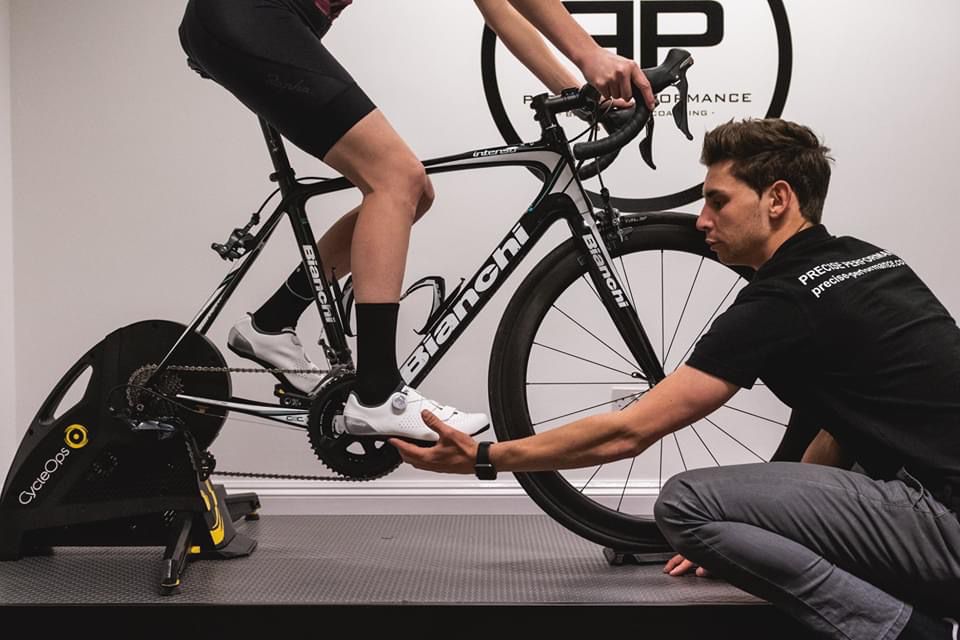
Yarranton analysing the pedal stroke
Once Yarranton’s examined these variables, he decides whether a rider needs an insole. “It's not that if we see forefoot angulation, we have to support it no matter what,” he says. “Some riders can actually get away without using an insole.”
Related — Rouleur Performance: Three cycling strength mistakes and how to avoid them.
Type of insoles
If you do need a new insole, however, you’ll have to decide whether you go for the customised option – “This is the best option but understandably it’s more costly,” says Yarranton – or the most suitable generic insole. These differ in shape and stiffness and start around £25. Or, an alternative in between full-custom and off-the-shelves ones are semi-customised insoles, which have different type of wedges you can position under a generic insole, Yarranton explains.
The importance of comforting your feet can’t be understated as, while you might suffer from pain in your hips or knees, the actual problem stems from a major contact point – your feet. In short, a relatively minor expenditure could be the chance of goal-setting and goal-getting.


