


The D40 is the road that connects the exit from the motorway to the town of Wallers in Northern France. It’s an utterly nondescript wide stretch of tarmac that cuts past neatly ploughed fields, usually quiet apart from a few speeding cars, indistinguishable from almost any other road in this part of the world. If you know where to look though – it just takes a quick glance to see it – the D40 is home to one of cycling’s most revered stretches of land. Through a small opening in the trees that line one side of the asphalt, there are cobblestones, jagged and glistening. It’s for this reason that every year, one weekend in early April, this unremarkable part of France comes to life.
On that particular, special Sunday, the usually barren curb of the D40 becomes obscured by hundreds of messily parked cars and people jump out of their vehicles to walk down the centre of the road, carrying picnic baskets, beers and barbecues. Some hold radios that ring out with commentary, some wave homemade flags splayed with the faces and names of their favourite riders. This is Paris-Roubaix day, and they’re all heading to the Arenberg forest.
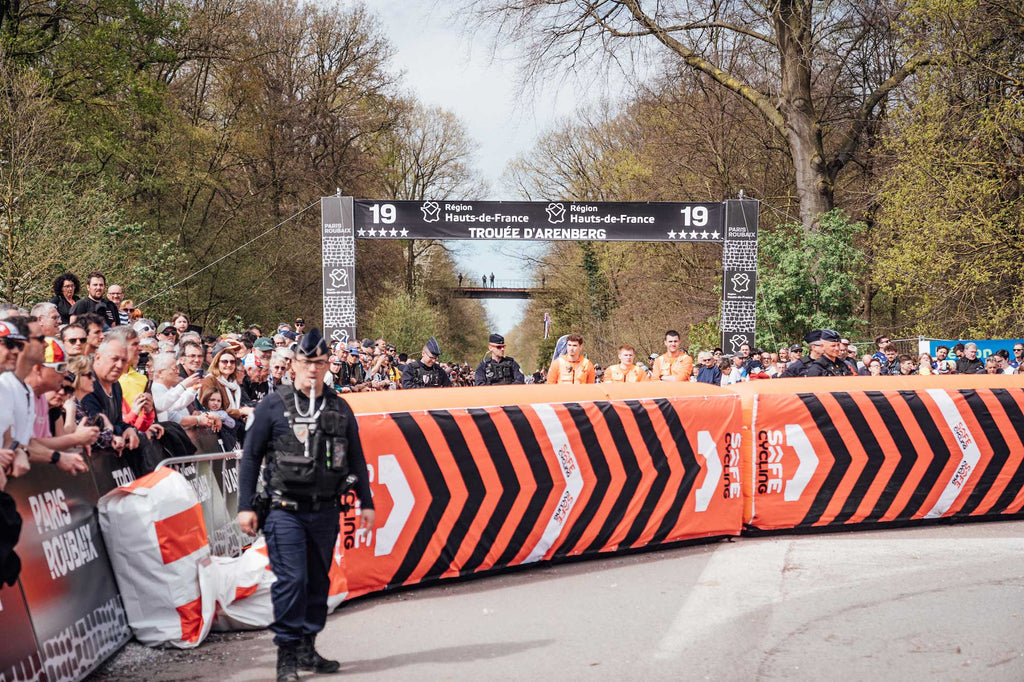
Image: Zac Williams/SWpix
The Trouée d'Arenberg is home to a 2.3 kilometre stretch of some of the most severe cobblestones in the entirety of professional cycling. On the morning of Roubaix, it becomes lined with fans – muddy boots in wet puddles, camping chairs and blankets laying claim the best viewpoints, music playing, sandwiches eaten in between speculation about when the peloton will eventually clatter through. The waiting is all part of the experience. When the gendarmerie start shouting at tipsy spectators to clear off the cobbles, and the photographer’s motorcycles speed past throwing up splatters of mud, you know that the riders are getting closer. First, you hear the propeller of the helicopter, then it’s the start of the race convoy. The moment draws in.
There’s a spot at almost the exact midway point of the Arenberg where, if you squint, you can see both the exit and the entry to the mythical sector 19. I found it this year and stood in sardine-like formation with a group of Dutch and Belgian fans who craned their necks for a view of their favourite bike riders. Van der Poel! Van der Poel! They screeched when, in a flash of white, the world champion glided over the sharp stones, his rivals gritting their teeth to hang on to his wheel. The approach the peloton had taken to the Arenberg this year was different, with chicanes at the entry to try and slow momentum before fragile bikes and bones hit the cobbles, but Van der Poel and his followers still passed us in a breathtakingly fast flash.

Image: Pauline Ballet/A.S.O
Once the front group had gone, riders kept coming in dribs and drabs. Some looked angry, some looked determined and some looked close to tears as their bodies were shook by the severity of the terrain. Shadows of dust stained weathered faces and bikes clanged and jolted as if they were shouting in protest about being forced over the cobbles. Men at the back were trying to dodge through team cars and motorbikes, riding with dogged fight despite the race disappearing in a cloud of dust in front of them. Each was thinking of the feeling of eventually making it to the velodrome, dreaming of the achievement of riding those legendary concrete banks.
Soon, it was time for us to think about that too. After hours of waiting, the bike race had come and gone in what felt like a few short minutes and the next race between the spectators started. Elbows out and bunch skills activated, it was time to battle back down the Arenberg and return to the D40, where we jumped in our cars and hoped that we would make it to the Roubaix velodrome in time to watch the riders arrive a few hours later. It was a scramble to get back on the motorway as traffic built up and people tooted their horns in an adrenaline-filled rush. They were ready to move on. Arenberg has had its yearly moment in the spotlight.
Eventually, when the last cars had left and the final picnics had been packed away, the D40 would return back to its peaceful, sleepy state. Just another road in France again. Until next year, Paris-Roubaix.
Cover image: Zac Williams/SWpix


